Table of Contents
The edge computing autonomous vehicles 2025 2026 market is advancing rapidly as automakers and technology companies invest in faster, safer, and more intelligent mobility systems. By processing information closer to the vehicle, edge computing reduces dependence on centralized cloud infrastructure and enables autonomous driving systems to respond to road conditions almost instantly.
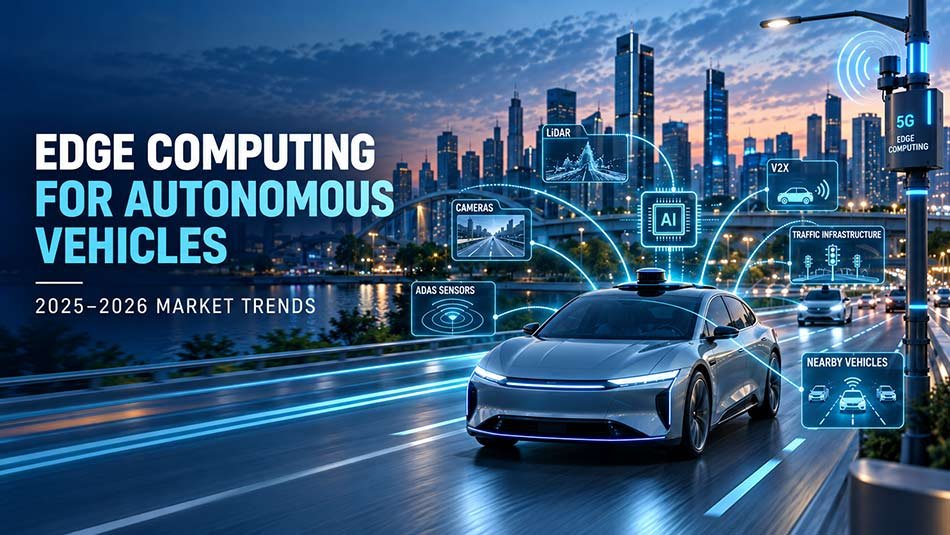
This technology is becoming essential as modern vehicles generate enormous volumes of data through cameras, radar, LiDAR, GPS, and connected sensors. Processing this information locally helps vehicles detect obstacles, recognize pedestrians, interpret traffic signals, and make critical driving decisions with minimal delay.
According to the original DataM Intelligence press release published on openPR, the global market was valued at approximately $7.64 billion in 2024 and is projected to reach $39 billion by 2032, representing a compound annual growth rate of 22.60% from 2025 to 2032.
Why Edge Computing Is Important for Autonomous Vehicles
The growing interest in edge computing autonomous vehicles 2025 2026 is closely connected to the need for real-time decision-making. Autonomous vehicles cannot always wait for information to travel to a remote cloud server and return. Even a short delay can affect braking, steering, lane detection, or collision avoidance.
Edge computing addresses this issue by analyzing data inside the vehicle or through nearby roadside infrastructure. Its primary benefits include:
- Faster processing of sensor and environmental data
- Reduced latency during safety-critical decisions
- Lower dependence on continuous cloud connectivity
- More efficient use of network bandwidth
- Improved protection of sensitive vehicle data
- Stronger support for advanced driver-assistance systems
- Better communication between vehicles and infrastructure
These capabilities allow autonomous mobility systems to operate more reliably in congested cities, remote areas, and other environments where network connectivity may be inconsistent.
ADAS and Real-Time Vehicle Intelligence
Advanced driver-assistance systems, commonly known as ADAS, are among the leading applications supporting the edge computing autonomous vehicles 2025 2026 market. ADAS technologies rely on rapid data analysis to provide functions such as automatic emergency braking, adaptive cruise control, lane-keeping assistance, blind-spot detection, and parking support.
AI-enabled edge processors allow these systems to interpret information from multiple sensors simultaneously. Instead of sending all data to the cloud, vehicles can evaluate their surroundings locally and take immediate action.
As ADAS becomes standard across more passenger and commercial vehicles, demand is expected to increase for high-performance automotive processors, edge AI platforms, advanced sensors, and integrated vehicle software.
The Growing Role of V2X Communication
Vehicle-to-everything, or V2X, communication is another major factor influencing market development. V2X technology allows vehicles to communicate with other vehicles, pedestrians, traffic signals, road infrastructure, and wider transportation networks.
The combination of V2X and edge computing autonomous vehicles 2025 2026 technologies can improve traffic management and road safety by enabling faster information exchange. For example, connected vehicles may receive immediate warnings about accidents, road closures, emergency vehicles, dangerous weather, or sudden traffic congestion.
The expansion of 5G networks is expected to strengthen these capabilities by providing high-speed, low-latency connectivity. However, local edge processing will remain important because vehicles must continue operating safely when mobile network coverage is limited.
AI Chips Are Transforming Autonomous Driving
Specialized AI chips have become a central part of autonomous vehicle development. These processors are designed to handle complex workloads such as image recognition, object classification, sensor fusion, route planning, and behavioral prediction.
In the edge computing autonomous vehicles 2025 2026 landscape, companies are focusing on energy-efficient processors that can deliver strong performance without generating excessive heat or consuming too much power. These requirements are particularly important for electric and autonomous vehicles, where energy efficiency directly affects driving range.
Leading technology and automotive companies operating in this market include:
- NVIDIA
- Intel and Mobileye
- Qualcomm Technologies
- Tesla
- Waymo
- Baidu Apollo
- Bosch
- Huawei
- Amazon Web Services
- Microsoft Azure
Competition among these companies is accelerating innovation in automotive hardware, edge software, cloud integration, cybersecurity, and autonomous driving platforms.
Major Market Segments
The market can be evaluated across several important categories.
By Component
- Hardware
- Software
- Professional and managed services
Hardware includes processors, sensors, storage systems, and vehicle computing units. Software covers artificial intelligence, analytics, operating platforms, and security solutions.
By Deployment Model
- On-premises or in-vehicle systems
- Cloud-based infrastructure
- Hybrid edge-cloud environments
Hybrid systems are gaining attention because they combine immediate local processing with the storage, analysis, and scalability offered by cloud platforms.
By Connectivity
- 5G
- 4G/LTE
- Wi-Fi
- Dedicated short-range communication
By Vehicle Type
- Passenger vehicles
- Commercial vehicles
By Application
- Autonomous driving
- Predictive maintenance
- Vehicle telematics
- Fleet management
- Traffic management
- Infotainment
- Digital cockpits
Regional Market Outlook
Regional investment is playing an important role in the expansion of edge computing autonomous vehicles 2025 2026 solutions.
North America remains a significant market because of its established technology companies, autonomous vehicle testing programs, AI chip development, and investment in connected transportation infrastructure.
Asia-Pacific is expected to generate substantial growth, supported by large automotive manufacturing industries in China, Japan, and South Korea. Smart-city projects, 5G deployment, and government-backed mobility initiatives are also encouraging the adoption of edge-enabled transportation systems.
Europe continues to advance through strong automotive engineering capabilities, strict safety requirements, connected-vehicle regulations, and investment in intelligent transport infrastructure.
The Middle East and Africa represent emerging opportunities as governments expand smart-city programs, digital infrastructure, and modern public transportation networks.
Market Challenges
Despite its growth potential, the industry faces several challenges. Developing automotive-grade computing platforms requires significant investment, specialized engineering expertise, and extensive safety testing.
Cybersecurity is another major concern. Connected and autonomous vehicles exchange sensitive information across multiple networks, making secure communication and data protection essential. Manufacturers must protect vehicle systems against unauthorized access while meeting evolving regulatory and privacy requirements.
Other challenges include:
- High implementation and infrastructure costs
- Lack of consistent technical standards
- Complex integration with existing vehicle platforms
- Limited 5G availability in certain regions
- Data privacy and cybersecurity risks
- Regulatory differences between countries
- Requirements for continuous software maintenance
Addressing these issues will require closer collaboration among automotive manufacturers, semiconductor companies, cloud providers, telecommunications businesses, regulators, and transportation authorities.
Future Outlook
The outlook for edge computing autonomous vehicles 2025 2026 remains positive as autonomous mobility progresses from controlled testing environments toward broader commercial adoption. Continued improvements in AI processors, sensors, 5G networks, V2X communication, and edge-cloud integration are expected to make vehicle systems faster and more dependable.
Future vehicles will increasingly function as intelligent computing platforms capable of processing information, communicating with surrounding infrastructure, and adapting to changing road conditions in real time. Edge technology will therefore play a central role in improving vehicle safety, supporting predictive maintenance, managing fleets, and enabling smarter transportation networks.
Conclusion
The edge computing autonomous vehicles 2025 2026an important intersection of automotive engineering, artificial intelligence, telecommunications, and cloud technology. Its continued development will help autonomous vehicles process complex information locally, respond more quickly, and operate with greater reliability.
As investment increases across ADAS, V2X, AI chips, cybersecurity, and intelligent infrastructure, edge computing is expected to become a foundational technology for the next generation of connected and autonomous mobility.